Temoinage

Architecture, Art, Design, Music, Photography & Writing

Tag: Architecture

Writing March 2014

NJB_Rice_1 

 the near, far and the in-between

(Neither Out Far Nor In Deep) [1]

The closest I was to Peter Rice was on the other side of a glass wall in what amounted to a gold fish bowl of an office in the basement of Norman Foster’s Office off Portland Place.  That was in 1986, a much different time and place.  We exchanged a glance shared by the Irish abroad finding comfort in recognising a fellow country man at distance.  Maybe it was some primal recognition of genetic origins, of facial traits, or bearing or maybe it was just the tweed jacket I was sporting at the time.  Nonetheless, whatever the reasons that knowing glance was as close as I would ever get to the person, a mere acknowledgment as he disappeared into the dark.  Therefore unlike some of my colleagues here my knowledge of Peter is affected by distance.  It is on this theme of distance that I would like to address the colloquium and to present a framework for understanding the work.  Rice might even like that, or to paraphrase; “once the rules are established everything else is easy”. [2]

His work had already attained cult status and his name joined a litany of great Victorian Engineers; the Brunels, Paxton, Stephenson and Telford who joined those of the modern era; Ove Arup, Robert Maillart, Luigi Nervi and Frei Otto.  The study of engineering genius was still part of the core curriculum of the late modernist school.  The work was however mediated through a few choice magazines in an environment starved of content compared to the current overload.  As architecture students we absorbed everything we could assuming that this familiarity would breed intimacy with our subject.  Nothing, however, prepares you for the real thing.


[1] The near, far and the in-between or to use the title of the Robert Frost Poem used in the Traces of Peter Rice Exhibition Catalogue, Neither Out Far Nor in Deep

[2] An Engineer Imagines – Peter Rice Artemis 1998

“When designing the main steel elements we had created a language of design.  We had tubes in compression, solid rods in tension and cast elements for joints.  Once these rules had become established everything else was easy.” P. 42


NJB_Rice_3_4images notes 4, 5


near

Though it seemed Peter was close in space that day in Fosters, the glass wall created a distance that no words could ford.  Without those words and before his insightful memoire I was left with mute buildings.  I would like to share my thoughts from that time.  When you chance upon the Centre George Pompidou it assaults your senses unlike the framed image from the magazine.  Gone from your thoughts is the contrasting colour against the 18th and 19th century facades, gone is the organising mantra of the vertical factory or the audacious externalised services.  Instead there is this urban theatre, a grand gesture opening up a people’s plaza in front of the building’s permanent scaffolding.  Before long you approach and engage viscerally with the building.  Tightrope walkers and urban gymnasts hang out of tie bars and on ropes suspended between.  At least this is how it felt ten years after its completion.   My experience was the equivalent of undertaking an autopsy on architecture; everything was revealed; cause and effect.   Nowhere could the elevation be found; eroded in favour of a dynamic composition of action and observation.  Instead an all consuming logic prevailed.  The building revealed a Victorian faith in the machine as the embodiment of enlightenment, a device to transport you to the future; instantaneously.  However this was no brutal engagement, no mere expedient construction.  Instead a hierarchy had been crafted to provide clarity to the diagram.  Each logic element had its own expression, its own weight and texture; partly polished, partly matt, partly painted with some elements cast.  Though obsessively factory made, there was an invitation to touch.  Permission had neither been asked nor given but taken by the people.  The need to reach out and touch its alien presence in the city pulled everyone closer, in the same manner you would reach out to the giant column masses of medieval cathedrals.  As if to confirm their ability to hold high vast amounts of masonry I found myself similarly placing a hand on these massive columns.  To be able to embrace and become part of the affirming nature of its promise is the search for the true nature of its expression that Rice spoke about.

“The search for the authentic character of a material is at the heart of any approach to engineering design.”[1]   If it were false in any way, if its material masqueraded as another all would be undone.  In photographs it was impossible to ascertain this truth.  In touching the thing itself it is revealed.


[1] An Engineer Imagines – Peter Rice Artemis 1998 P. 78

NJB_Rice_7_8


far

However though we would desire it, much of architecture remains aloof or distant in time and space.  To fulfil our ambition to understand and reveal the truth of any work requires considerable effort, funds and commitment.  As a consequence, magazines and now the internet intercede to provide a simulacrum of intentions.  The extensive availability of digital photography has provided a bridge to distant places but this remains stubbornly disjointed.  That the work of Rice and the teams in which he has collaborated remains powerful at a distance is testament to the rigour with which the language of parts is conducted.  The clarity and discipline of roles within the structure becomes a signifier of sorts for Rice’s work.  Within each project the task assigned to the column, the wall, the beam, the glass, the frame are carefully described to allow them their own space within the overall concept.  The overarching conceptual framework has at its heart is a permanent scaffold that was premièred in Pompidou.  In the collaborative work with Renzo Piano this takes flight, literally in Kansai Airport and in de Menil where the ceiling articulation is like sheets (sails) in the wind.  As it was with Utzon a singular idea holds the attention from afar, directing the attention of the observer to a few memorable images, stunningly photographed.  Despite these photogenic qualities the idea manages to cross from its’ reality to the mind’s eye, even if “The sand we used was marble sand and the cement was white, which gave a sparkle to the finish of the surface,” is lost in translation. [1]  The assured dissection of the problem and distribution of elements to a system of classification is worthy of the best of the Victorian Scientists and Engineers.

The potential there is for cacophony is arrested by the desire for dialogue.  In the drawings, sketches and models the clues to the types of dialogue emerge in time to provide a platform for understanding the relevance of the work.


[1] An Engineer Imagines – Peter Rice Artemis 1998 P. 90

NJB_Rice_10_11


in-between

It is at the nexus between concept and reality, between idea and touch that the work really excels.  It is there that the dialogue between engineer and architect, between designer and builder, between client and user is resolved.  The modern propensity for segregated thinking and segregated responsibilities would be more than happy to see any attempt at dialogue framed by a system of ring fenced borders where trade is embargoed.  Rice attests to the fact that to him the border does not exist.  I am mindful of the use of these terms coming from the territory he occupied as a young man, close to where I grew up along the border invisible in life but permanent in the minds of some.  Though an internationalist he refused to be dragged across the border or worse occupy the no-man’s land as Architect-Engineer or Engineer-Architect.  He steadfastly retreated from this special category of refugee instead expanding the potential of engineer to embrace a foreign language by resorting to an international language of Architecture.  “I am and engineer, pure and simple.” [1] His efforts however provide us with a Rosetta stone made from drawing, modelling, building, testing, trying, failing and succeeding to guide us in our own endeavours.  The joint is the touchstone, a fulcrum, the point around which everything rotates.  Unfortunately the joint would later become festishised by impersonators.  For Rice though it is the resolution of parts, it is where we come to know the man that was once glimpsed at the bottom of the garden, or in the basement office, as someone worth knowing. “Often it is the expressionism of the jointing which humanises the structures and justifies their friendly feel.”  [2] This common human exchange is concretised in this final thing, the residue of the knowing glance, recognising similar traits, equal in our humanity, but different in contribution, where anything is possible if you only have the courage, “just courage, care and attention to detail, and above all belief and getting started.” [3]


[1] Traces of Peter Rice – Edited by Kevin Barry Lilliput Press 2012 Renzo Piano Quoting Rice P. 19

[2] An Engineer Imagines – Peter Rice Artemis 1998 P.26

[3] An Engineer Imagines – Peter Rice Artemis 1998  P.126


NJB_Rice_Last

the near, far and the in-between

(Neither Out Far Nor In Deep)

NCAD_RiceExhibit_Sydney_241013

© Noel J Brady 2013

presented as part of Peter Rice Colloquium at NCAD 2013

Image credits

hands:  http://www.centreculturelirlandais.com/modules/movie/scenes/home/index.php?fuseAction=popup&rubric=art&article=art_may2013

 geberette: http://www.engineering-timelines.com/who/Rice_P/ricePeter5.asp

 ironbridge:  http://www.sedgleymanor.com/people/abraham_darby.html

chalkboard: http://www.engineering-timelines.com/who/Rice_P/ricePeter3.asp

sydney sketch:  http://www.sydneycloseup.com/sydney-opera-house-facts.html

ibm: http://www.structuremag.org/article.aspx?articleID=476

scarpa: http://www.pinterest.com/pin/418623727834266390/


Architecture March 2014

Fulcrum – ARDS Peninsula Installation

The possibility of constructing architecture from standardized parts is a long held dream of the modern movement.  With a nostalgic view of the future some pioneers believed that the future could be transparent, functional, streamlined and efficient if it followed the dream of Henry Ford’s production line.  “More Ford than Marx”, went the catchphrase.   However industrialised processes in Architecture are neither new nor exclusively modern.  In ancient Rome the standardization of Brick production facilitated the building of an empire as did their standardisation of armour, currency and most especially roads.

NJBA_553_Design_Section


In an age of austerity industrialsed and standardised elements are often drawn upon to facilitate works that might not otherwise be affordable.  This is NJBA A+U’s entry for the Ards Peninsula competition which draws upon the limitations of material to surpass the usual.   

NJBA_553_Exploded_1

The proposal sees a tower constructed of standard plywood sheeting (with minimal cuts) fixed to a timber frame and using hinges to manufacture a triangular box.  Stacked in a pattern of twos these “boxes” would form a 5 storey tower accessed by a  stair ladder.  Designed to be placed anywhere in the park area Fulcrum would enable the viewer to engage with the trees or the coastline.  

SONY DSC


With rudimentary skills this tower can be erected on a relatively small footprint with its own concrete foundation.  The size of the panel systems easily provides the necessary protective environment safe.  And should the structure be considered meaningful through use the elements would provide the formwork for a more permanent concrete tower on the same platform.  

Architecture is too often seen without the myriad temporary structures that went into its construction.  Here the scaffold has become permanent, the formwork without the from, the standard identifying with the unique.

Architecture February 2014

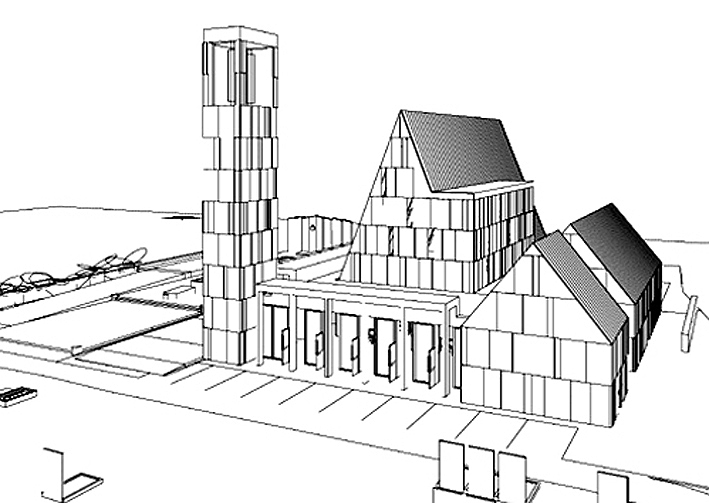
This entry is the report submitted as part of the submission by NJBA A+U to the international competition for a centenary chapel at Glasnevin in Dublin.

place – the end “alpha & omega”
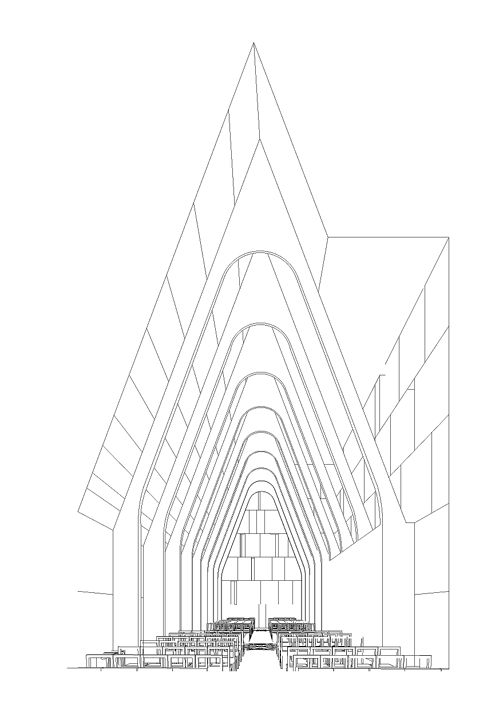
Death is an end and the beginning of things, to different believers. Located at the end of the cemetery between two railway tracks it cannot be any further along the path of remembrance. It is the last place that the suns rays fall in the day. This work attempts to draw attention, a full stop to that end by anchoring the chapel/temple to that place. The work points itself into the end space embracing a new and mixed landscape to provide space for visitors to halt their movements and reflect on the nature of life, its joys and fears.

541_Report_PlanSite_091213

place – the beginning
From left to right (top to bottom) a place has been prepared to remember the paupers randomly interred with a cherry tree lined columbarium and meditation pool. This augments and parallels the 1916 memorial which in turn is augmented by a long plaza that projects into the new landscaped end of the site. Parallel to this is placed the new chapel/temple with its reflecting pool and garden. Parking is provided in neutral spaces across the front of the site to minimise their impact. This is a place of parallels of equality.

541_Report_InteriorB
architecture – arrangement
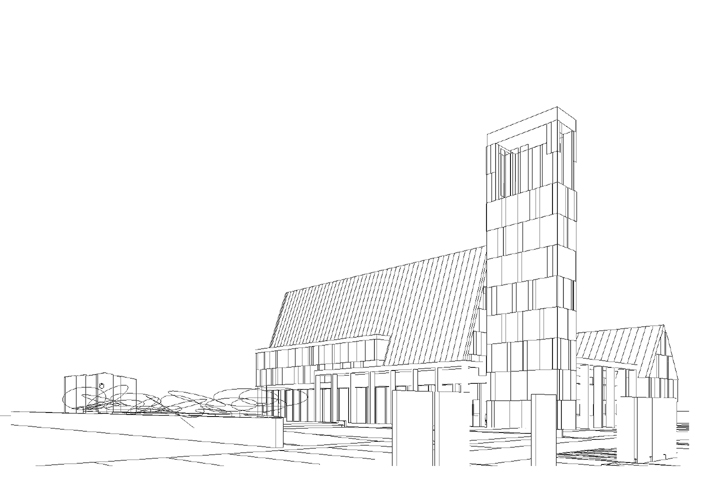
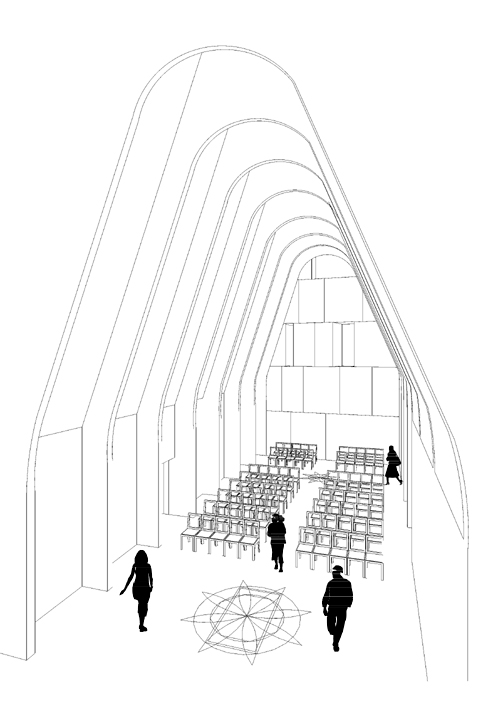
At the centre of the organisation is the chapel/temple. This is centred on the catafalque. Chairs are used rather than benches to maximise the individual arrangements for specific creeds. This is wrapped with a columnar space that responds to the new plaza and the large foyer. To the south a service zone for the backup functions is places. A carillon tower anchors the building to the plaza. The elements are made like four “stones” set into the landscape with a pathway binding them together.

atmosphere – light
The intention was to provide a solemn and quiet place allowing light to enter discretely as if invited. The chapel/temple (the centre “stone”) is pierced by slits in the elevation on each side. The room will be experienced differently on each visit. Artificial light will be used to augment this atmosphere using discrete fittings placed in correspondence with the main structure and in the deep walls. The stone and concrete finishes have been chosen to mute the visual spectrum to be solemn and quiet.

atmosphere – sound
The heavy stone and concrete elements are used to silence the external world. The structure of the room breaks up the sound to flatten acoustic resonance. The thick walls and roof system will include acoustic resonance panels to assist the design of the sound space of the chapel/temple.
atmosphere – temperature & humidity
A significant amount of thermal mass has been chosen to provide a stable uniform quality throughout the year. Embedded heat exchangers in the floors and walls will enable the building to be responsive to the changing seasons. The combination of concrete super structure and stone elements provides for equally stable moisture content.
541_Report_PerspectiveB
function – carillon
The carillon theme has been proposed to anchor the site and the location of the chapel/temple to this place. It is located at the entrance point for the complex to greet the mourner/visitor. Standing tall it marks the beginning also of the new plaza. This represents the first “stone” in the composition.

541_Report_InteriorC
function – chapel/temple
The second “stone” of the composition is the main one, the chapel/temple. As a multidenominational space it is planned to be flexible to the needs of the congregation. The space is centred in the middle on the location of the catafalque. The chairs rather than benches can be located as shown or according to the demands of specific ceremonies moved out of the way completely. This is subject to the management of the facility though. Directly accessible from the main foyer it has access on two other sides for service personal and serving clerics.
The arrangement allows for the exit of mourners to the east end of the facility into the plaza and the contemplative gardens of the work. The arrangement provides for maximum flexibility without sacrificing architectural consistency.

function – ancillary spaces
The remaining functions are gathered together as a pair of “stones”. The most important of these, the sacristy/robing spaces are placed at the eastern end of the composition with two spaces directly linked by the columnar space surrounding the chapel/temple. Next door to this a private toilet is provided along with a service room for environmental services, a storage room for a minimum of four coffins and the administration office, accessible from the secondary service entrance. To the southern side of the building this external area constitutes the service area for access by the hearse and other service vehicles. The other part of the pair of “stones” is the discrete public toilets providing male, female and universal access toilets for the use of the public. These are accessible both from the main foyer and the outside. As the last of the “stones” it frames the entrances at the front and service entrance to the side.

541_Report_InteriorA

function – foyer/columnar space
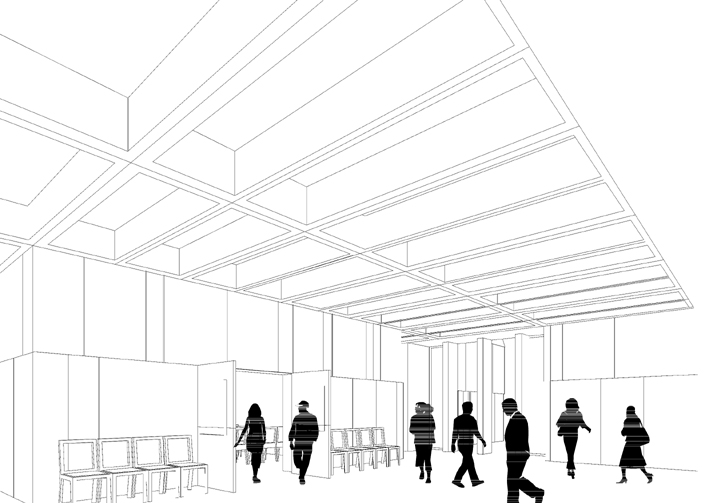
Connecting the four “stones” is a brightly lit columnar ringed space providing generous space for a minimum of 100 mourners with direct access to the chapel/ temple. It is close to the administration office, rear lobby and public toilets. Secondary access to the chapel temple is made available on both sides, providing a route for coffins to the south along with a link to the sacristies/ robing spaces and the universal access toilet for use of celebrants/masters of ceremonies.
tectonics
With a super structure mainly consisting of concrete piled foundations, raft floors, waffle slab roofs (to the main foyer spaces), main chapel/temple trusses the clarity of the structure is a major contributor to the character of the building. To ensure that quality is at the foremost of this decision most of this work is either bespoke or precast under factory conditions. Columns and walls are reconstituted concrete/stone hybrid and the roof is finished in either a tern coated steel or zinc.
architecture and meaning

541_Report_PerspectiveC
This work is an attempt to imbue a sense of gravitas and resonance to the making of space. Purposefully the composition is resonant of that found in St. Kevin’s chapel at Glendalough or other ancient temples. The composition is based on four “stones”, an analogy
for the landscape strategy and for the tectonic expression of its large blocks of reconstituted concrete/stone. Light enters in between these large elements conveying their quarried logic. In a field of monuments the work rises up on the same proportional grid as its graves. Anchored and anchoring the 1916 Centenary Chapel is a place of the past, for now and the future.

12 Publishers

Our blog at WordPress has been a little quiet for most of 2013.  2014 will hoepfully see a new and more dynamic strategy develop where ideas are moved through this venue first. Stay tuned…..

Version

Version_Name_Blurb_2012

12 Publishers has launched Version, a multidisciplinary booklet/zine available in digital format and as print on demand package. The mission is to present a range of enquiries across the fields of Architecture, Art, Design, Music, Photography and Writing. The original intention was to bring into the open material that has previously been seen by very few as a reflective process. The planned editions are open ended with no set date for completion. It is expected though that the material presented in the zine editions will be reassembled in different formats in the future. The zine could be considered a foundation for future publishing concepts.
Our first complete edition is Version 12.2.1 “the impossible memorial”, documenting the memorial to victims of abuse (ireland) by NJBA A+U. This is available to purchase from Blurb and to download as an e-book. Future plans include Version 12.1.1, “competing visions”, a range of competition entries by NJBA A+U, Version 12.3.1 “identity”, identity design from synthetic reality and Version 12.4.1 “water power”, sleeve notes for MEC the first experimental music album by Oblique Projection.
The Verison logo is based on the renaissance vescia symbol. The original reference is being used here for is gateway reference (to design based material in this case). A specific logotype has been created by synthetic reality for this purpose as well.
The 6 areas of enquiry are colour coded according to the colour wheel (in alphabetical order) and numbered accordingly from Architecture to Writing. The numerical system derives from this and is unlimited. The colour and number scheme is therefore;
Yellow 12.1 Architecture
Green 12.2 Art
Blue 12.3 Design
Purple 12.4 Music
Red 12.5 Photography
Orange 12.6 Writing
The chosen font is Trebuchet MS, a reasonable common typeface which falls between Arial and Helvetica in terms of recognition while having some traditional characteristics. The zine will have a common template for covers based on the colour logic above. The subject of the cover will be a suitably abstract image from the content. Only “Version” and the relevant number along with the logo will appear on the cover as the identifier.

Version_Logo_Blurb_2012

Welcome to 12 Publishers

Weclome to the 12 Publishers WordPress Blog. 2013 will, we hope, be a significant year for our work across all of the inter related fields of Architecture, Art, Design, Music, Photography and Writing. Our new website http://www.12publishers.com has gone live and further details will emerge in its new format. In addition to the WordPress Blog, we operate facebook pages for NJBA A+U (Architecture), Synthetic Reality (Design) and Oblique Projection (Music). We hope to add more material in the coming months. Through Blurb.com we will also be releasing a number of physical publications as well as e-books. Watch or read this space.