Temoinage

Architecture, Art, Design, Music, Photography & Writing

synth-fashion September 2025

Synth Fashion has been around in some guise for a while and recently relocated to the EU. After consideration of various platforms, we choose Spreadshirt to be our preferred partner.

We are adding retail outlet capabilities to our site, to support an expansion of our activities. Merchandise may be directly related to some of the outputs e.g. music CDs. and in other cases, just fun stuff, T-shirts, etc. We are not selling advertising space to third parties or other corporate bodies, and we do not capture cookies for any form of processing.

Our Spreadshop Synth Fashion is the first of these to be launched. Sep 2025

https://synth-fashion.myspreadshop.ie

Music January 2025

A video to celebrate starts. As a piece that also talks to the start of the week Monday Morning (2016) from Cycles (2016), this video was originally created in 2016. The art work Somewhere Else (2016) is by Martin Boyle, exhibited at Visual in Carlow, Ireland.

Monday Morning (2016) from Cycles (2016). Art work Somewhere Else (2016) by Martin Boyle

Cycles by Oblique Projection

Design January 2025

A return to the blog is long overdue. 2025 is a year of significant change across many dimensions so I am taking some time to go back to the earliest motivations and inspirations for practice. When I returned to Ireland from the US in 1990I had an inclination to establish a multi-disciplinary practice. In the very early years of salaried employment I instead began exploring non-traditional design problems. Open Idea Competitions like Forma Finlandia offered wild card platforms to think and dream without boundaries. By 1994 I established Synthetic Reality (inventive design) as a vehicle for these activities in parallel with setting up NJBA A+U (towards an integrated environment). These activities are now being folded into Parenthesis Research ltd.. As part of an archiving project I unearthed one of my earliest projects, which was devised in 1992, and later was subject of a conversation with Apple (Ireland) in 1995. NDA’s were signed but there has been such significant progress in the meantime as to make this more a historical curiosity and insight into what might have been.

In the early 1990’s telecommunication devices were slowly evolving alongside the new digital technologies. Handsets would soon be liberated to become mobile and by the end of the 1990’s the first PDA’s (Personal Digital Assistants) emerged. The Nokia 2110 was launched in 1996 which ‘provided e-mail; calendar, address book, calculator and notebook applications; text-based Web browsing; and could send and receive faxes. When closed, the device could be used as a digital cellular telephone’. (https://en.wikipedia.org/wiki/Smartphone).

In 1992 it was against this backdrop that the Databook proposal was pitched, which brought together some of the elements that have become synonymous with Smartphones today, Camera, Recorder and Notes. There was nothing similar in the industry when I approached Apple in 1995. There was no evidence that the iPhone was even a consideration.

From the original text that accompanied the design in 1992.

‘The Digital Databook is for use in areas where it is may be necessary to record notes, sketches and speech. The Databook can be used with the need for mains electricity. It carries its own rechargeable battery. The functional aspects of the Databook have been kept to a minimum. Instead the operator may quickly record his/her observations. on returning to base these files may be downloaded onto a PC or Laptop Computer. The Databook recharges at the same time. The basic structure of the Databook allows for the development of scanners and camera like elements expanding the Databook to become the complete surveyors’ tool. Useful for police and emergency services the Databook can be easily carried in a pocket. The plastic chassis allows circuit boards to be fully supported while providing the necessary protection.’

Looking back now at the approach to launch a Minimally Viable Product in 1992 prefigures the Lean Start-up methodology that is prevalent today. That coupled with its combination of different functions in the same device or platform appears anachronistic. It was 2000 before Sharp produced and released the J-SH04 a phone with a camera and the multi-functional Smartphone platform would not appear until the launch of the iPhone in 2007, 12 years after my approach to Apple in 1995. If only…

This is a curiosity from the vaults, unique in its offering, even if limited in deliverables, but a signpost to the dynamic nature of the early 1990’s and beyond. Today with the astronomical explosion in computer power and sophisticated interfaces, high quality resolution cameras and recording, the Databook appears like a toy, a relic of ancient technology. Who knows where the conversation with Apple could have gone. That, they say, is another story. There have been many stories since, but a new horizon beckons. Here’s to 2025 and new destinations.

Noel Brady CEO Parenthesis Research Ltd.

Art June 2021

Dunree Fort – Site of Engagement

Gathering

Following an open invitation by Artlink my proposal for a collection of three objects devised around the theme of pilgrimage was selected for the open art exhibition at Dunree Fort in the Inishowen Peninsula, County Donegal (Ireland).

Gathering – Concept Model of Creels Proposal

This proposal takes a number of sources as inspiration for establishing a temporary (permanent) art work at Fort Dunree.  These include a nod to the pilgrim trail (Turas Colm Cille) of St. Columba (Colmcille), where the pilgrim is entreated to mark various sites by circumnavigating various crosses and stele three times (“The pilgrim circles the cairn three times, praying, and then, placing his back to the stone, makes a declaration renouncing the World, the Flesh, and the Devil.”).  In two instances there are three circles (Cloch an Aonaigh, “The Stone of the Assembly” & Gannew and Curreen townland) located on a single cross and in another three squares (Straid townland, with echoes of the labyrinth).   

This composition has three vessels for gathering, which echo the form of wicker baskets and creels, shaped in part like ballistic shells.

The material framework provides the visitor with a legible framework and interactive container.  Visitors are encouraged to carry with them a stone (white) to locate in the container.  Over time the artefact and its material reality will change, according to its exposure and its vulnerability to the elements.

Gathering – Maquette (for scale)

The maquette shows the scale of the creels and how the creel will be populated by visitors.  This gathering is purposefully permeable, illustrating the ultimate futility of containment and the fragility of permanence.

The material for these creels is readily available, constructed from reinforcing bar and mild steel wire which is spot welded to form the creels. A base plate facilitates the anchoring to the vessel to the concrete pad.  The metal is untreated and left to oxidise.

Gathering – Maquette

From simple materials this proposal seeks to address the sacred, in terms of both placement and idea.  It also nods to the influence of the site, both materially and functionally.  As an active participatory installation it will take on different values according to each visitor and begin a movement to repopulate with new ideas.  It is hoped by interfacing with this installation that the visitor will think anew about site and place, and the relationship of human activities.

Noel Brady (transdisciplinary artist)

The Group Exhibition will run during July and August 2021

This work has been made possible by the generous support of ArtLink and The Arts Council of Ireland

Architecture June 2020

Bishop Lucey Park, Cork – Design Competition

3rd place in international competition

NJBA_677_NE_Axon_Final_sm

Warp & Weft, a dynamic threshold for Cork

The scheme takes its inspiration and character from unearthing the archaeological remnants of the old city of Cork.  The burgage plotlines inform both pattern of path and place. A stone veneer is laid uniformly, as a warp and weft pattern, across the gentle slope rising from Grand Parade and South Main Street.

SheetC_202069_BLP

This design facilitates a permeable connection between these two thoroughfares, by removing fences, walls and barriers. Introducing a uniform design character gives structure and legibility to the space, consisting of 3.6 m high portals.  This architectonic device provides a regula for the space.

NJBA_677_SouthParade_Axon_Final_sm

To address the barrier-like fortified wall, a metal and glass grill covers an artificially illuminated cavity. Elsewhere archaeological structures emerge to contain raised wildflower beds.  Linear timber seating encircles this archipelago of planters.

NJBA_677_Cafe_Final_sm

The space adjoining Grand Parade has been cleared to facilitate temporary events such as music performances and a new café is proposed to face south onto a courtyard shared with the public house on the corner of Tuckey Street.

C:Data_NJBA677 - Bishop Lucey Park677 - Design677_ElevationsThe construction consists of veneers (stone paving and timber seating) and discrete retaining or point load structures, (concrete walls, steel and timber frames).  Artificial lighting is integrated into the portals across the whole of the park which can be modified to suit different thematic and temporal conditions.

NJBA_677_Fences_Final_sm


As neither square nor park, the design is a blended mix of art and architecture, landscape and urbanism.  It is purposefully a neutral yet dynamic framework that bridges the distance between the old and the new city of Cork.

Urbanism February 2020

Cavan Market Square

Between 2018 and early 2019 NJBA A+U provided urban design research and a vision for the much maligned Market Square in Cavan Town, Ireland.  This multi-level design research exercise enfolded the shareholders, the local authority and town team in a process which evolved to make a dramatic intervention in the centre of this old urban centre.

History

The earliest extant record of the town dates from 1591 which identifies two (long demolished) castles, one on the hill overlooking the town and the other set into the fabric of the town next to the Franciscan friary.  Mapping this over the more contemporary fabric it reveals the relationship of the various artifacts to the morphology of the town’s streets.

Market

What remains of the original Victorian Market Square is a pale reflection of its earlier form.  At the centre near what appears to be a well on the 1591 map the old market house was demolished in the 1960’s to make way for a different hub, the general Post office.

Design Challenge

Initial research into the temporary use of the remaining area suggested a different alignment for market stalls that re-affirmed the street condition and cleared a space for people to engage in a truly urban space.  This emphaised the lost opportunity that existed hidden behind the newer fabric, that is the abbeylands, where it is reputed that the body of Owen Roe O’Neill is interred.  Aside from the historical resonance of this space the spatial pattern at the heart of the town is at stake.  With the support of the main stakeholder, the post office, a new idea emerged.

Abbeylands

Re-aligning, re-positioning, re-situating would allow a new connection to the heart of the medieval town that was anchored around the old friary, whose church suffered at least three catastrophic fires.  It remains an empty unloved and oft forgotten void.  By identifying the key boundaries of the centre; between Town hall Street, Main Street, Bridge Street and Abbey Street, the centre can be re-invigorated, and re-connected to its place.

The relationship between church and market space can once again be reunited.  A new branded scheme clarifying the core can become the anchor for a new identity for historic Cavan.

Urbanism

Engaging local stakeholders required a multi-disciplinary approach to communicating ideas and engaging interest.  Combining, drawings, plans, sketches, computer and physical models helped convey the reality of the proposal, eliciting generous, welcome and critical comments.

Simulating before and after proposals were the most effective, especially those that portrayed the reality of the impacts through photo-montages, that reflected what viewers were already familiar.

ViewD_1200_noPO_sm

Simulation

Simulating or imagining the use of the space was even more effective in convincing the audience of the substantial benefits accruing from the dramatic changes.  The new vision offered a 400% increase in usable public space at the heart of the town, capable of holding exhibition sports events (Tennis / Basketball), small concerts and a more substantial civic space.

Design 

Emptying the space is not sufficient in itself.  Instead a framework that reinforced the street condition of Main Street, provides the infrastructure for temporary accommodation when and if markets are required.  This disciplines the often random nature of such events without compromising the operation or enjoyment of the space.

ViewB_1200_noPO_sm

Next Steps

Currently the Abbeylands are subject of a new urban masterplan which suggests that significant changes will emerge for this effort and finally the town will be rewarded with a market square that holds the heart of the town in the centre.

njba a+u was commissioned by the Cavan Town Team to provide a vision in conjunction with he key stakeholders surrounding the space.

Design February 2020

Material x 3

Synthetic Reality’s output increased in the first month of the new decade.  Aiming to launch at least one design per month has seen three new designs launched on the Design by Humans platform.   The target is to double the designs available on the platform in 2020 (40). Currently 23 differing designs are available for purchase.

syntheticshop_feb2020_sm

1 Magellan

Magellan was designed as a new logo for the Portuguese Space Agency as part of an open innovation engagement.  Regretfully overlooked SR has repurposed it as the logo for a fictional space mission.  The Magellan iconography includes a depiction of the constellation of Dorado (The Dolphin). The subdivision of the blue sky identifies the four cardinal directions necessary for terrestrial navigation.


Two versions of the Magellan mission T-shirt; a team badge version and then a full sized version above.

2 Diversity

Diversity is another re-worked idea around the idea of diversity and celebration.  An abstracted idea of arms raised in celebration it doubles as a bird like “flying free” symbol.  This is available in a bright version or faded version.

3 Drift

Drift was inspired by the observation of ice floes in a river and the fragmentary but unified character of the image created an interesting but balanced dynamic.

Drift_WhiteonBlue_T_sm

Drift White (on Blue)

Three versions are available, Blue, Red and White on a wide variety of T-Shirts and other tops.   With an ambitious range of topics for 2020 Synthetic will be busy responding to the demand for new concepts.


Further details: https://www.designbyhumans.com/shop/Synthetic/

Design January 2020

New Parenthesis Research Logo

2020 seems like a good year to advance plans and ideas.  So it is for Parenthesis Research.  In developing this new logo it was important to find a suitable image that would unite the various threads that make up the back story of setting up the company and its new mission.

Mission

Parenthesis Research‘s emergent mission is to provide innovation for companies at all levels of business.   With a background in design and business the company is the next step evolution from the early business iteration; Synthetic Reality.  The choice of name was pertinent to this mission.  Picking the singular form of  parenthesis “(” was deliberate as it denotes an open ended framing of the areas of research that the company is committed to undertaking.  Without boundaries the future remains open.  As an “umbrella” type organisation under which different research types might be sheltered also reinforces the use of the “(” symbol (even if in a 90 degree orientation.

Design

Parenthesis Stamp_080120sm © Parenthesis Research / Synthetic Reality 2020

The chosen image emerged from a sketch exercise attempting to unify the disparate but simultaneous images of Tree, Umbrella, Infinity while evoking a crafted or hand worked element.

This is united to the brand name and includes a subtle hint to origins in Synthetic Reality, with the capitalisation of the last letter.

Parenthesis logo_080120 copy

© Parenthesis Research / Synthetic Reality 2020

As we progress through 2020 more details will  emerge from the mission and current and planned projects.

parenthesisresearch@gmail.com

NB 09 01 2020

Writing June 2019

Across the hill; Giants

The sound of the hard ball leaving the bat echoed along the front street.  Screams pulled the boy from tree to tree.  Above them chestnut leaves spread out filtering sunlight.  In the grove at the intersection of the back street and great hill gathered the children of summer.  They came from the nearby cottages to meet their cousins from town.  Under this canopy they held council on the world in between games of tag and hide and seek but none would venture towards the hill.  Until the sun left the sky they occupied the outside realm while adults held their council indoors.  Sometimes, to pass the time, they would throw sticks at young chestnuts, only to be disappointed, secretly wishing for autumn but loving the summer.  As the shadows grew long so did their stories.  With backs against the heavy trunks they wove a fabric to resist the creeping cold.  One story concerned a race of giants that lived across the hill.  John was nine when he first heard the story.  It was late and shadows had given way to thick shade and though the sky remained azure with orange clouds, the valley grew dark.   The laneway that led up the hill between a hedge and row of beech trees was darker still.  He stared at this emptiness as the story unfolded of how they had withdrawn to the nearby forest secreted away from others.  “Sometimes you can hear them play rounders”, the eldest boy explained, “ever see lightning, the crack is the ball flying from the bat and thunder, that’s the sound of the giants running the bases”.  When the call home came, John welcomed it.  Stars had begun to appear and as he sauntered home he heard the faint rumble of thunder.  Nervously he looked back into the darkness.  Sleep eventually enveloped him.  The following morning John took himself outside.  The air was sharp and the filled with fresh rain.  In the Chestnut grove he looked up through the thicket of branch and leaf to the sky.  Leaning on the trunk he watched the tree top twist in the wind.  As his arms stretched out and embraced the tree he felt the pull of the wind on its knotted bark.  A sudden crack turned his head towards the hill.  Across the back street, a small stream and through the gate to the lane he started.  As he climbed the beech row to his side opened out onto the plateau of the hill.  At the top he saw the valley fall beneath him the rivers and lakes joined together bathed in morning light.  He wondered if this is how giants saw the world.


Number of words = 444

© Jon Gregory 07 April 2012

Architecture May 2019

A Bridge to Remembering

“The bridge gathers to itself in its own way earth and sky, divinities and mortals.”

Martin Heidegger Building, Dwelling Thinking

Introduction

Competition Entry Report for Commemorative Bridge at the Irish War Memorial Islandbridge, Dublin

Gathering

Making a bridge provides the opportunity to gather the world, unifying the heaven and earth, the past and future.  It gathers up the earth, the banks and the river into a single thing.  In this location the bridge must prepare the visitor for the journey across the river to the memorial gardens.  This design brings together ideas about pilgrimage, memory and order.

Arrival

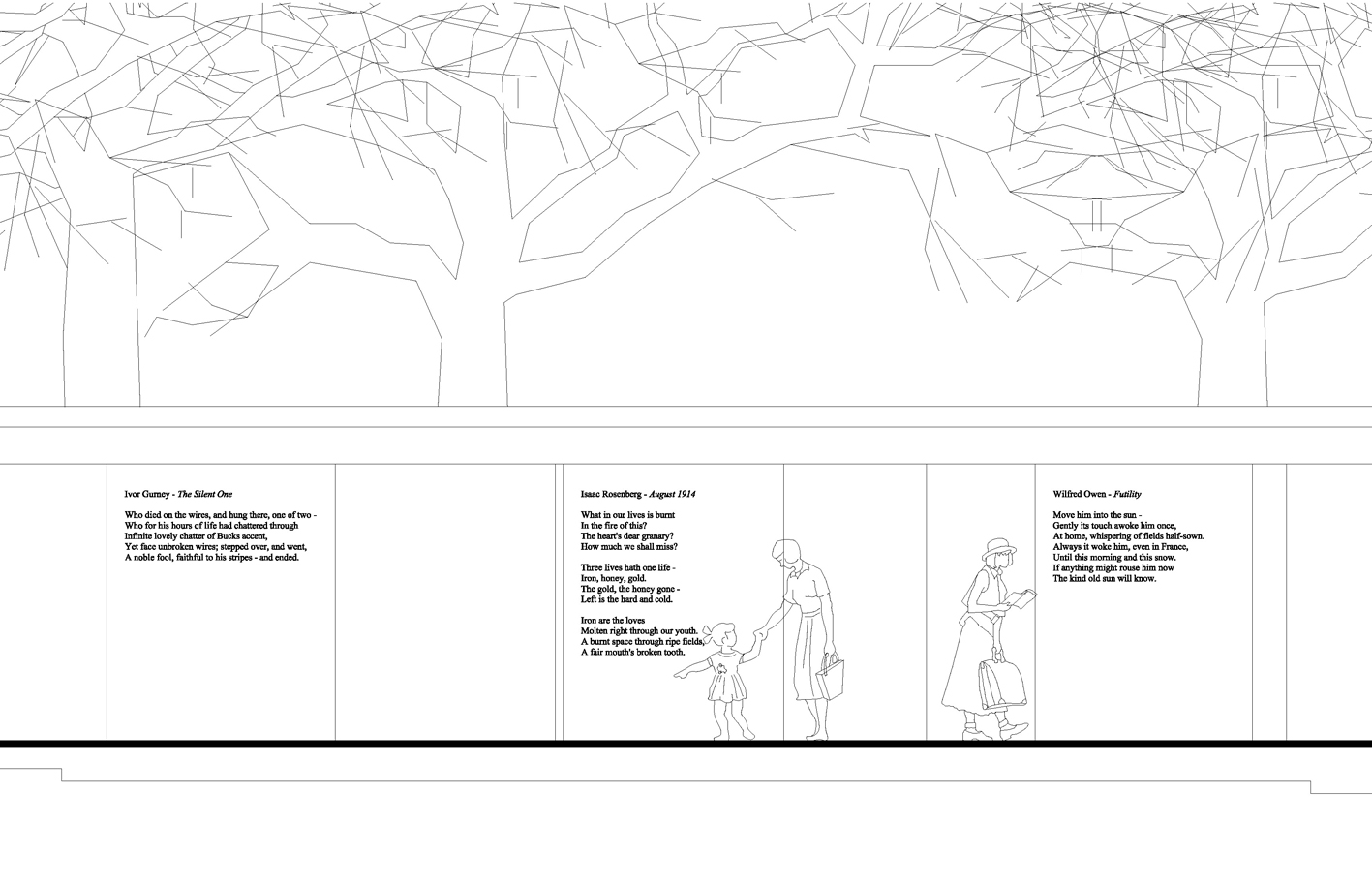
According to (Camillo) Sitte, the urban space before the church should be narrow and long, an extension of the processional route.  Here to shelter and enfold the visitor the prepared space is surrounded by stone walls that carry the engraved words of the war poets; a testament to the loss of innocence.  Water flows along each side and echo off the curved entablature to further calm the pilgrim.


Sound & Poetry

The courtyard provides a tranquil and isolated space in the busy city for the visitor to slow down.  This transition is a necessary purification process that prepares the visitor for the journey to the memorial garden.  The screening walls are formed to deflect and contain the sound of flowing water.  The concrete elements can be precast allowing their placement with minimal disturbance on the existing ground.  Openings to the rear allow the sound of birds and the wind in the trees of the nature sanctuary to percolate into the space.

Anchoring & Threshold

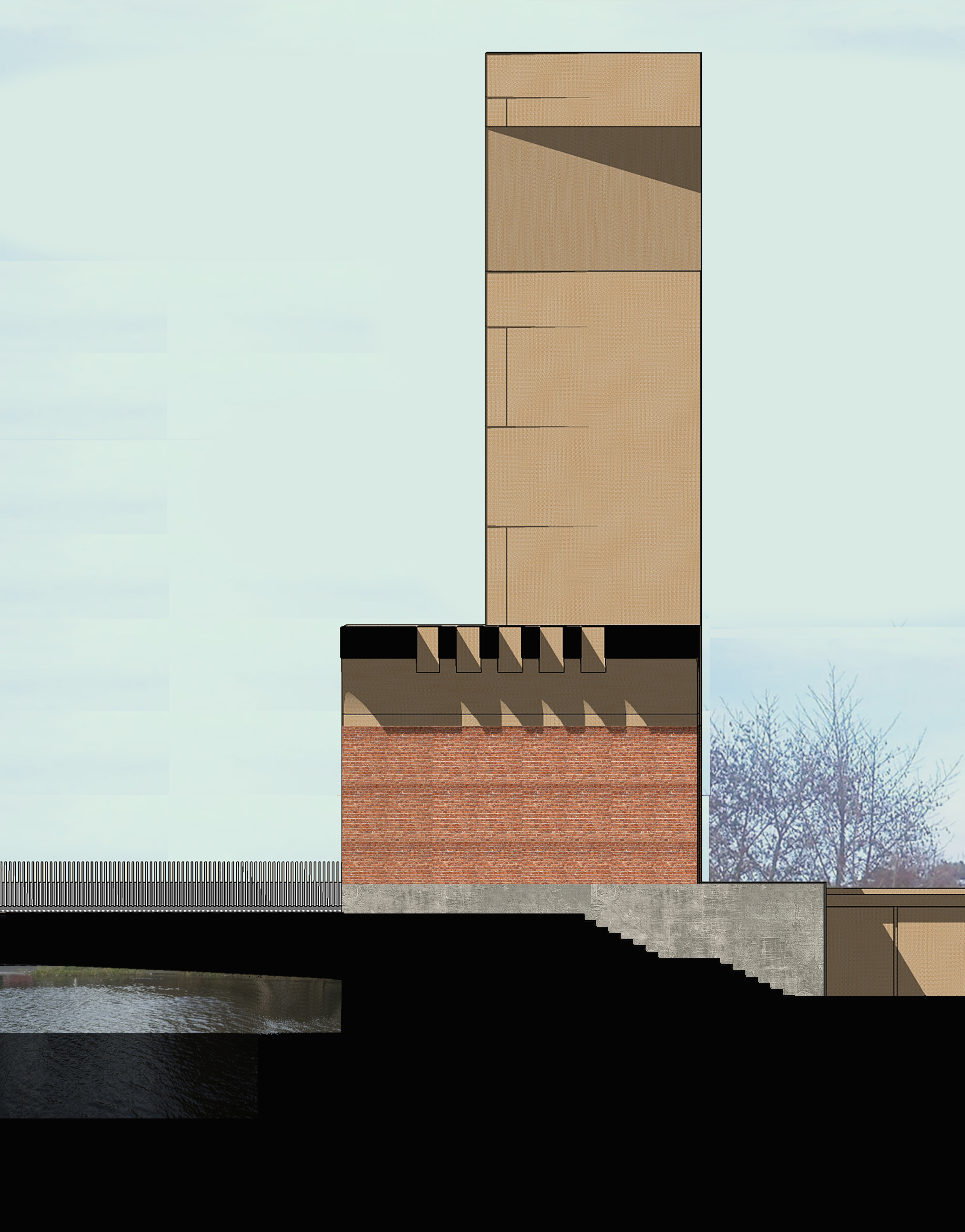
The bridge element is anchored to each bank with an entrance portico, a threshold that signals the crossing.  These embankment elements resolve the unique topography on both sides of the river, allowing for full universal access.  A hydraulic lift and staircase are provided inside the buttress element.  This strategy provides for a flat arrival court at +5.0 M and a flat bridge deck at +7.1 M.  This approach allows for 2.1 M clearance beneath the arch over the river as well allowing the river path on the southern shore to be uninterrupted.  These weighty anchors provide the necessary restraint for the bridge (see structural description below).  The northern portico element is also marked by a bell tower.  It is proposed that a bronze bell be commissioned as the percentage art project.

The Divided Path

In the medieval world the visitors to the great cathedrals were directed (under the eyes of Christ) to enter by one door and once their pilgrimage was satisfied, exited by the other.  These double doors are divided by the pillar that supports a Vesica Piscis above.  The porticos provide a similar choice.  The vaulted gateways are illuminated from above.  The allusions to both the Medieval Cathedral and Lutyens’ war graves motifs are not accidental.  The vaulted gateways frame the space and provide a sense of scale while providing clues to distance.


Material Character

The materials are driven by topography.  Concrete provide the material of abutment and bridge, brick the middle ground, while stone completes the entablature, extending to the structure of the bell tower.  Concrete provides defence against the vagaries of rising and falling water, marking the plimsoll line of the structure.  Brick provides tactile warmth.  The hard wearing surfaces are paved in stone, slabs over the courtyard and the bridge deck. Stone cobbles mark the crossing from one realm to another and completes the structures by capping the porticos and faces the courtyard walls.

Structure

The proposed bridge spans 45 metres from two concrete platforms.  To minimise the impact of the bridge on the environs the design carves out a narrow zone of impact.  The first stage is the sinking of piles and caps upon which the abutments will be constructed. The walls of the stair cores create a rigid box to connect the bridge.  The abutment foundation is anchored to the pile caps and in turn provides the landing point for the bridge’s arched soffit and flat parapet.

Sequence

The bridge can be erected simultaneously from both embankments using cranes located on the abutment foundations.  These lift the bridge segments into place. The first three segments are connected by joining steel cable strands together and tensioning them. The last segments can be connected using post-tension strands on-site and then lifting in place, with the final “keystone” dropped into place locking the structure together.

The bridge design balances nearly all of the self-weight of the bridge.  The tendons are located near the bottom of the cross section at mid-span, near the top of the section where bridge meets abutment, and then somewhere near the centre of the cross section at the far end of abutment or end of bridge.  Post-tensioning the tendons will pre-compress the concrete in the region of the cross section where there is tension due to bending under applied load.  Additional pre-stressing to ensure compression throughout the depth of section in the unoccupied bridge is used so that tension stress is never greater than the pre-compression.  This provides good deflection performance and long term durability.  The bridge will be built using C50/60 concrete and 15mm 7-wire post-tension strands.  At the base of the bridge we need 10×22 strands on each side and at middle 8×22 strands in total.  Additional 2-wire crossing strands, perpendicular to the main strands, will be placed 1m c/c.

Environment – Construction

The construction of the bridge relies less on disturbing and more on placement.  Aside from the piles and caps there is little disturbance envisaged for any part of the construction.  No significant excavation is envisaged for any construction with new surfaces established above or at the existing grade levels.  The arrival court is formed using cut and fill to accommodate the new levels at or near the existing grade level of the roadway.  The southern portico is accessed by a simple path, land graded either side to minimise its physical impact.

Environment – Post Construction

The post construction environment is similar to that prior to the introduction of the bridge, the mature trees (with one or two exceptions) are maintained and a nature enclave is protected (encouraged even) to the eastern side of the arrival court.  The existing river line and footpath are maintained.   The extent of the impact remains a narrow strip with limited impact outside of this zone.   Access to the bridge is facilitated using stairs, ramps and elevators.  It can be isolated or secured by decorative gates if required.


Marking Time

Marked by the sound of a bell, the sound of water, the mark of words, the echoes of people and place, this project had the ambition to enfold space and time with sound, light and words to guide and effect a change in the visitor.


Credits copyright reserved by authors

Design & Concept NJBA A+U; Noel Brady

Design & Engineering Bakkala Consulting Engineers; Chris Bakala, Erik Altmäe

Cost Analysis KMCS; Nigel Spence, Anthony Devane